


AI-Driven Autonomous Lab: How GPT-5 Is Changing Scientific Research Forever
Artificial intelligence is no longer limited to chatbots or coding assistants. A new breakthrough known as the AI-driven autonomous lab is transforming how scientific experiments are planned, executed, and optimized. Powered by advanced AI models like GPT-5 and fully automated laboratory systems, this technology is redefining the future of research.
In simple terms, an AI-driven autonomous lab is a smart laboratory where artificial intelligence takes care of the thinking, planning, and decision-making, while robots and automation handle the physical experiments. This powerful combination allows science to move faster, cheaper, and more efficiently than ever before.
What Is an AI-Driven Autonomous Lab?
An AI-driven autonomous lab is a closed-loop system where AI designs experiments, runs them using automated machines, analyzes the results, and then decides what to try next. Unlike traditional labs, which require constant human supervision, these labs can operate continuously with minimal human involvement.
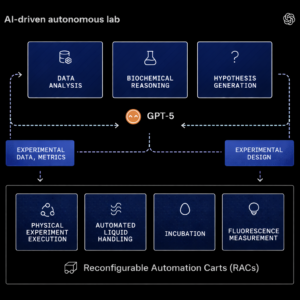
In recent research, GPT-5 was used as the brain of such a lab. It planned experiments, generated hypotheses, analyzed large datasets, and refined future experiments based on real results. Automated lab equipment then executed those experiments precisely and consistently.
How GPT-5 Powers Autonomous Research
GPT-5 plays a critical role by acting as the scientific decision-maker. It performs tasks such as:
• Analyzing experimental data
• Understanding biochemical relationships
• Generating new hypotheses
• Designing optimized experiments
Once GPT-5 creates an experiment plan, the instructions are validated to ensure they are safe and physically possible. The experiments are then carried out by robotic systems that handle liquid dispensing, incubation, and measurement without human error.
Massive Cost Reduction and Higher Efficiency
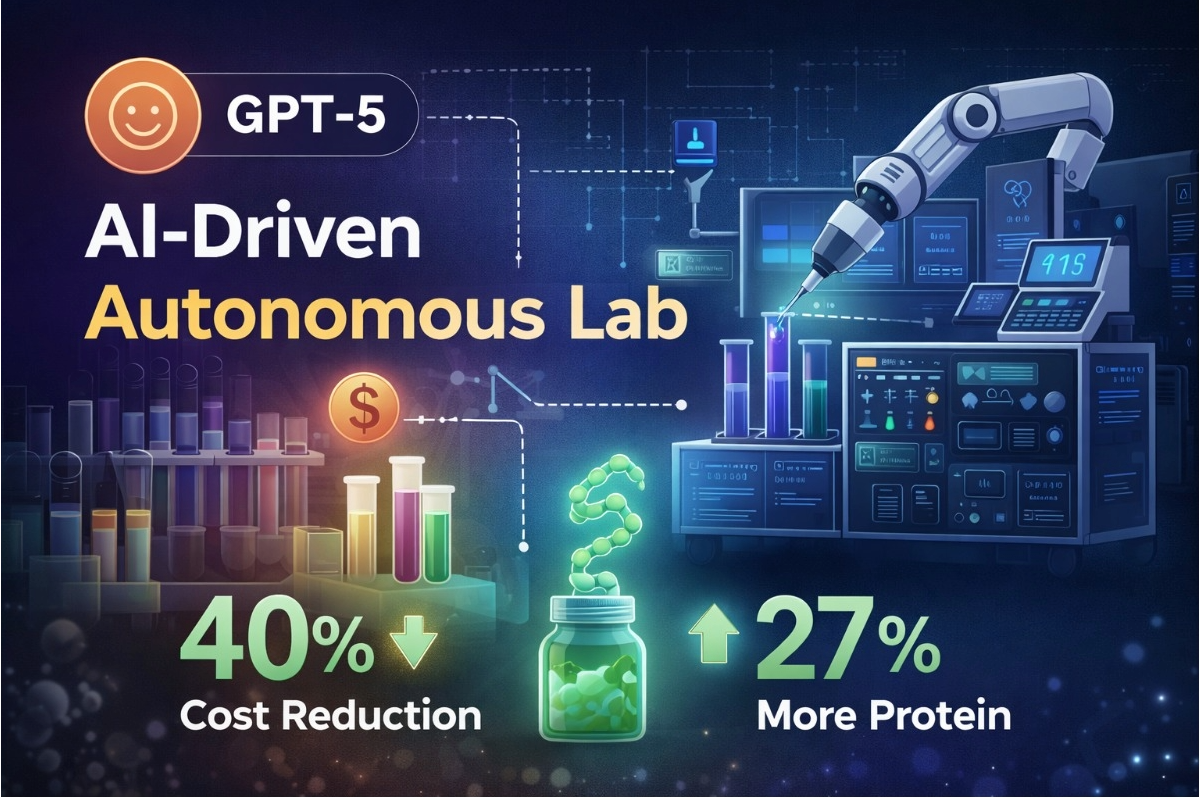
One of the biggest achievements of AI-driven autonomous labs is cost efficiency. In a real-world protein synthesis experiment, this system reduced protein production costs by 40% while increasing output by 27%. Normally, improving quality or output increases costs, but AI was able to optimize both at the same time.
This breakthrough proves that AI can find better solutions by testing thousands of combinations that humans simply do not have the time or resources to explore.
Why This Matters for Science and Industry
The impact of autonomous labs goes far beyond academic research. Industries that rely on laboratory testing and optimization can benefit significantly, including:
• Biotechnology
• Pharmaceuticals
• Healthcare
• Chemical engineering
• Synthetic biology
By reducing costs and speeding up experimentation, companies can bring new medicines, treatments, and technologies to market faster.
Automated Labs Work 24/7
Unlike human researchers, AI-driven labs do not need breaks. They can run experiments around the clock, analyze results instantly, and adapt strategies in real time. This dramatically shortens research timelines from years to months or even weeks.
More importantly, AI-driven labs reduce human error. Automated systems deliver consistent results, while AI ensures experiments are designed logically and efficiently.
A Step Toward Fully Autonomous Science
This technology represents a major shift toward self-driving science. While human scientists still define goals and review outcomes, much of the routine work is now handled by AI and machines.
In the future, autonomous labs could tackle complex challenges such as drug discovery, protein design, climate research, and material science with minimal human intervention.
The rise of autonomous labs is closely connected to advances in AI models. Recently, Claude Opus 4.6 introduced major improvements in long-running agent tasks and large-scale reasoning, making AI-driven research systems even more powerful.
Final Thoughts
AI-driven autonomous labs powered by GPT-5 are not science fiction anymore. They are real, working systems that are already delivering better results at lower costs. By combining artificial intelligence with advanced lab automation, researchers are unlocking a faster, smarter, and more scalable approach to scientific discovery.
As AI technology continues to evolve, autonomous labs are expected to become the standard across research institutions and industries worldwide.
🔗 Want to dive deeper into all the new features? Read more here!
Category: News, AI Tech
